

A former HR manager received a message containing laughing emojis from her boss after she experienced redundancy during pregnancy. The employment tribunal has awarded her over £21,000 in compensation. Read on to find out more about the facts and judgment of this case, together with consideration of pregnancy discrimination and pregnant employee rights.
HR Manager Claims Pregnancy Discrimination
The HR manager commenced employment in February 2023. She passed her probationary period, and her managers appeared pleased with her work. She was offered the position of onsite director; however, she turned this down because she was expecting a baby. In late August 2023, she then informed her boss that she was pregnant.
The HR manager’s boss subsequently secured new investors for the organisation and decided to resign. On 9 September, the boss then told her to inform employees, “Staff are made redundant for the next six weeks”. Following this, a number of communications between the two took place over several days before she ultimately emailed her boss, stating that, based on her performance at the organisation, “If I did not tell you that I am pregnant, you would not think about making me redundant.”
Read: Maternity and Pregnancy Discrimination: Social Media Marketer Told She Had a Baby at the Wrong Time
There was no further communication between the HR manager and her boss for two weeks. On 22 September, though, her boss messaged her, stating that the new management required the key to her office. The HR manager requested to meet the new managers herself, but her boss said they were “not going to meet any staff on an individual basis.”
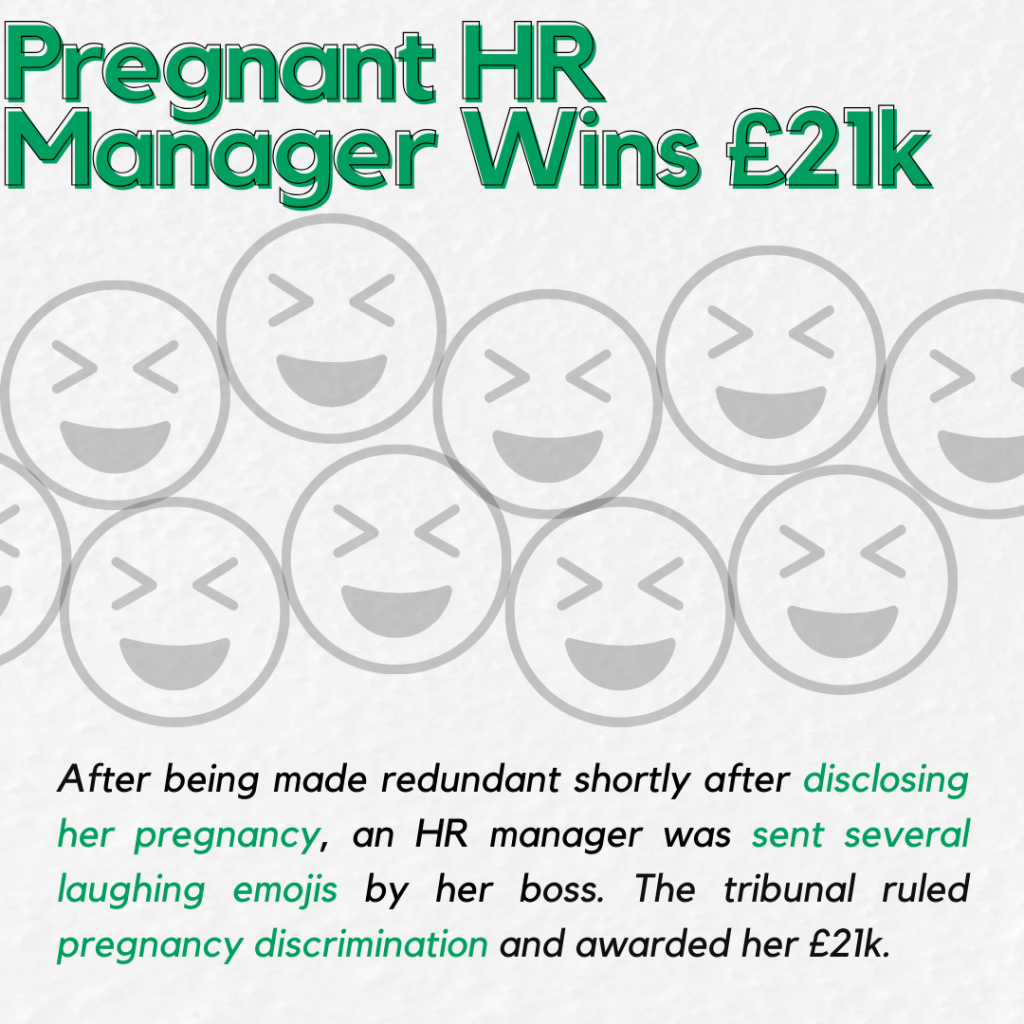
To this, the HR manager replied: “That’s fine. Since you’ve already stepped down, I will wait until the new management officially starts their work and get in touch with me regarding the key.” Her boss responded with seven laughing emojis. At this point, the HR manager believed her employment had been terminated, as she wasn’t expected to return to her office. As such, she brought a claim of unfavourable treatment due to pregnancy.
What Did the Employment Tribunal Say?
The HR manager’s claim was heard in the Glasgow Employment Tribunal. After consideration of the facts of the case, the tribunal held that she had indeed been treated unfavourably because she had been pregnant. This constituted discrimination on the grounds of pregnancy under the Equality Act 2010.
Like what you're reading? Don't forget to subscribe to our bi-weekly newsletter!
In its judgment, the tribunal noted that the HR manager’s boss had a “change of attitude” towards retaining her after discovering she was pregnant, resulting in her redundancy during pregnancy. It also highlighted that two other female employees, neither of whom was pregnant, were retained by the organisation. With respect to the treatment which she’d received, the tribunal stated that her boss had “scoffed” at her and that his communications in September 2023 had been “steeped in ambiguity”.
Speaking about the nature of the HR manager’s redundancy during pregnancy, the tribunal accepted that the confusion caused by the manner in which her employer communicated the termination of her employment added to her stress. It added that “the callousness of the laughing emoji message was particularly distressing.”
The employment tribunal ordered the HR manager’s former employer to pay her £21,681.99. This included compensation for injury to feelings, financial loss, and breach of contract (as the organisation had failed to provide notice for redundancy), as well as unpaid wages and payment in lieu of holiday.
What Is Pregnancy Discrimination?
Pregnancy discrimination is the act of treating someone unfavourably because they are pregnant. It may involve a single action or result from a particular policy or rule. It is not necessary to prove that others (i.e. those who were not pregnant) were treated more favourably in comparison, simply that the employee in question received unfavourable treatment – whether or not this was intentional.
Pregnancy and maternity are protected characteristics under the Equality Act 2010, and pregnant employee rights apply to employees, agency workers, freelance staff, contractors, and casual workers. Such pregnant employee rights apply from the beginning of pregnancy up to the end of the maternity leave – up to 52 weeks. For those not entitled to maternity leave (for instance, agency workers), the period will end two weeks after the date of childbirth.
Read: 64% of Pregnant Women Received Hurtful Comments About Appearance from Bosses, New Research Reveals
There are pregnant employee rights which employers are obliged to honour. One of these is the right not to receive unfavourable treatment as a result of pregnancy, illness suffered as a result of pregnancy, or being on or seeking to extend maternity leave. Examples of such unfavourable treatment might include being dismissed or made redundant, being rejected for promotion, having pay or hours reduced, or receiving pressure to leave a job.
Get Employment Law Help
If you have experienced pregnancy discrimination, you may be able to bring a claim against your employer. The friendly team of employment law experts at Redmans Solicitors would be pleased to discuss your experience and advise on the next steps. Contact them today to arrange a free, confidential consultation to find out how they can help you.
Before you go, make sure to subscribe to our newsletter. It’s the only way to stay informed about the latest employment law news, like this story about the HR manager, and you won’t want to miss what we have in store!